
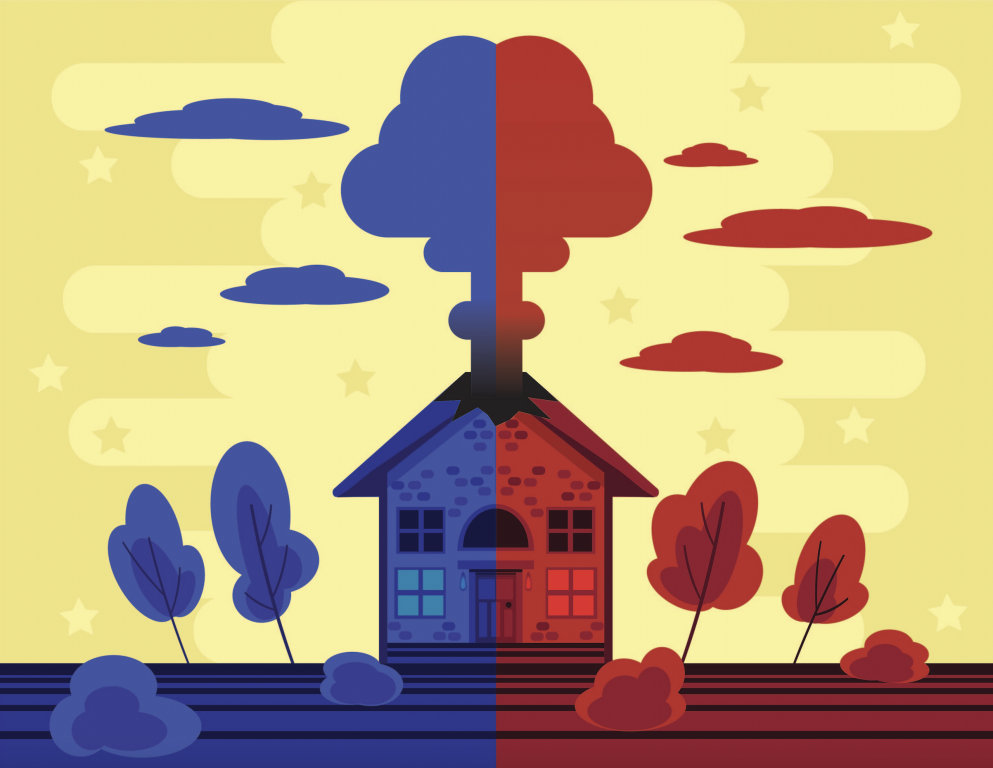
Politics have become messy.
Public trust in institutions has dwindled. Discourse has become strained. People have increasingly segmented themselves off in groups. And public displays — both from public officials and the populace — deemed uncivil, consume headlines week after week.
Audrey Faunce, a second-year University of Idaho law student, remembers growing up around politics. She and her father, Ken Faunce, chair of the Moscow Human Rights Commission, were often found together at downtown rallies and city council meetings.
Faunce, who identifies as liberal, said broaching political subjects with tact always is overrated. Drawing comparisons with historical examples, such as the Boston Tea Party, the Stonewall riots, the marches for women’s suffrage, Faunce said shaking the political norm is an important tool for movements.
“None of those would have been deemed civil in those times, but they changed the politics in that era,” Faunce said. “While in a perfect world civility in politics would be wonderful, I think at this point it is overrated. There is a time and a place for it and I find that that’s actually rare.”
On the other side of the political spectrum sits Mitch Royer, a UI fourth-year studying agribusiness who grew up in Cambridge, Idaho.
Royer, a conservative and self-proclaimed history buff, believes two presidents best represent the golden age of politics: former presidents Franklin D. Roosevelt and Ronald Reagan.
Royer, like many, doesn’t know how or when politics became so divisive. However, he attributes much of the tension to social media, or what he likes to call “political media.”
“Everything is so politically fueled in today’s time that it’s getting counter-productive,” Royer said.

Over the last few decades, the general electorate has become increasingly polarized, with members of Congress becoming even more separated, said Markie McBrayer, a political science lecturer at UI.
“If you ask them nowadays how they identify, they are further apart then they were 20 years ago even. The change has happened relatively dramatically since the 1980s,” McBrayer said.
Historically, she said political ideologies have had multiple dimensions — social and economic — but that over time those have become intertwined.
“You had conservative Democrats and liberal Republicans, but really in the past 30 years you’ve seen those sort of merge. In the wake of that we see polarization,” McBrayer said.
Brian Ellison, assistant professor of political science at UI, pegs the current political climate — in large part — to weakening institutions.
Two examples of the breakdown he offered were winner-take-all or single member congressional districts and the Electoral College’s choice for president breaking with the popular vote in 2016.
“It’s a really sort of dangerous situation,” Ellison said. “We have a government that does not have the sanction of most people in the United States. That’s really rare.”
As the institutions break down, Ellison explains, public support weans, driving candidates to ideological extremities because they worry about being beat out by other candidates who are further in the fray.
“It’s not both sides. It’s not to say there are Democrats who are awful, but it’s mostly right now focused on the right. It’s been a seat change,” Ellison said.

Another explanation for how political polarization spiked is through how society processes and responds to information. Bart Baumgartner, a philosopher professor studying informatic processes, explained how two phenomena — echo chambers and the backfire effect — influence society.
Echo chambers are when we surround ourselves with information we agree with and distance ourselves from information we disagree with. On the other end, the backfire effect is how we respond to exposure to new information.
“When (people) are exposed to information or beliefs or arguments that are contrary to what they themselves believe, they sort of put up their defenses and get more entrenched in their particular belief,” Baumgartner said.
Royer and Faunce both recognize that social media has a sizeable influence on political discourse, but offer differing conclusions.
During the 2016 election, Faunce said social media likely showed more of the discrimination marginalized groups face regularly.
She believes what some might call incivility — political discourse in an unabashed manner through protests, activism and calling out discriminatory behavior as it happens — is the most effective way of getting people to reflect on their beliefs and actions.
“I feel like disruption of their day through a protest is going to get them to notice and will get them to hear more about the issue and that can maybe change their mind,” Faunce said. “I think that calling somebody a racist, which is apparently the worst thing you could call a white person ever, will snap a lot of people into the defense, but also maybe sometimes reflection.”
Royer said social media breeds resentment. The Future Farmers of America auctioneer said he worries contemporary American political culture draws similarities with the Roman Empire before its collapse.
“We are at an era in our fairly young country’s political spectrum where we are more focused on in-fighting than the better good of the country,” Royer said.